

October 31, 2026
How To Eagle Watch Effectively
Here in Squamish, eagle season is among us! Over the next couple months we will see thousands of bald eagles arrive to feed on the spawned-out salmon on our many rivers. It’s during this time when eagle observation programmes such as our Eagle Watch program kick off to collect valuable data about these birds. If you are heading out looking for eagles, consider spending five minutes learning how to best spot and count them.
Eagle Identification
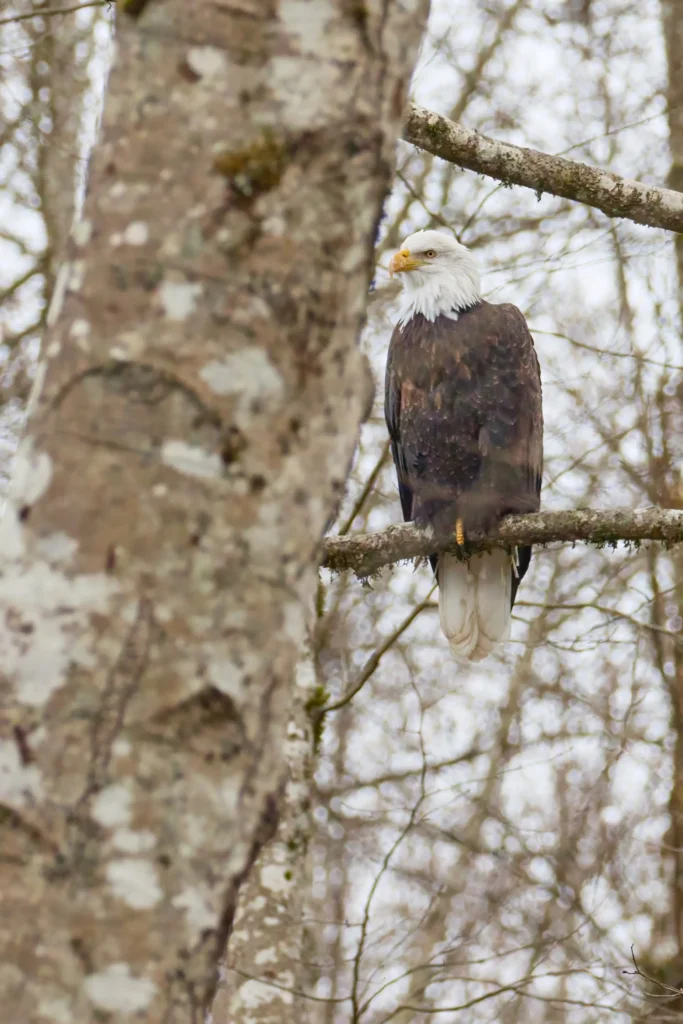
Thankfully, evolution made it easy to identify these amazing creatures. For those who are new to the eagles of North America, here is a quick run down of how to ID a bald eagle:
- Look for a large bird, larger than a heron.
- Adults have a white head and tail.
- Immature birds are mostly brown with some patchiness.
- Large yellow bill and feet.
We only really have one other species of eagle in this area, the golden eagle, and they are rarely seen here. Golden eagles tend to be brown all over, with a light brown/golden patch behind the head/neck, and white patches on the wings. Red-tailed hawks are similar to immature bald eagles but much smaller. Look for that large bill.
A Note on Eagle Age
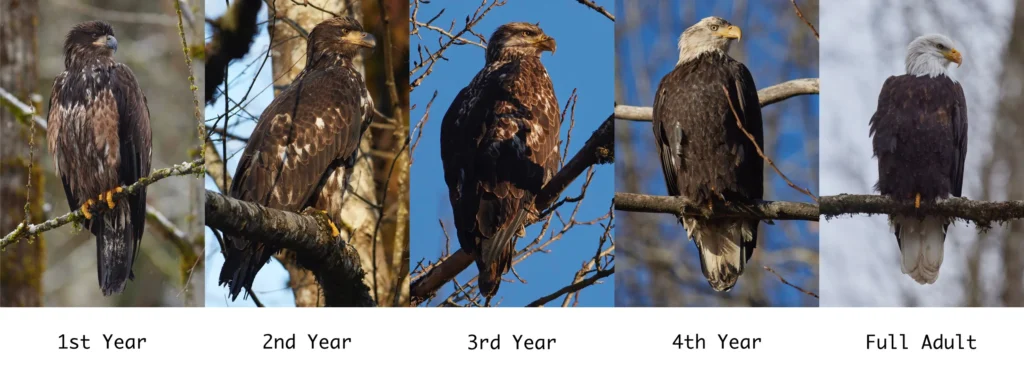
Bald eagles take around 5 years to reach that perfect white-brown-white plumage (called the definitive plumage). Immature birds gradually morph between all brown and definitive over time.
Below are some images of birds in yearly stages from juvenile to full adult, starting at half a year when young birds develop their first full plumage.
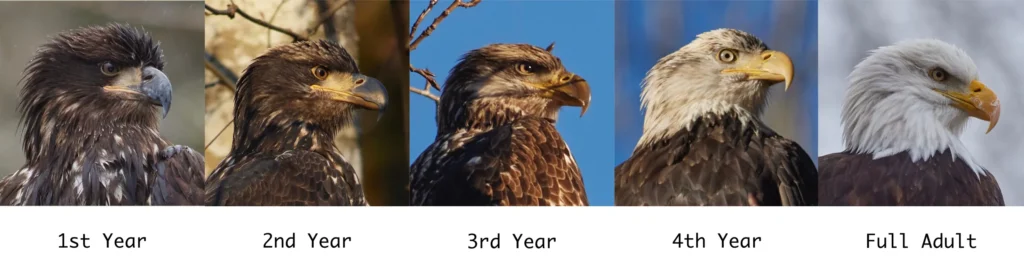
The main indicators of age are:
- The head and tail feathers.
- The eyes.
- The bill and cere.
In case you’re not familiar with bird anatomy:
- Cere: is the part of the bill where the nostrils are.
- Bill: is another name for a bird’s beak.
- Axillaries: are the feathers which appear to be in the bird’s armpit.
- Terminal band: is a dark band across the tail feathers.
- Hallux talons: are the talons which face backwards.
- Talons: are a bird’s claws.
Age Comparison
These side-by-side strips make the progression clear across all ages at a glance.
Full Body Comparison
Head Comparison
Spotting Eagles
Eagles are generally easy to spot when they are in flight due to their size and predictable flight pattern.
- Look for large broad wings held firmly.
- Wings are typically flat across the top unlike the ‘V’ shape of turkey vultures.
- Stable, intentional flight with infrequent flapping.
- Sometimes form ‘kettles’ where multiple eagles soar in circles on a thermal.
The difficulty starts when you begin looking for eagles in the trees, which is where they spend much of their time. Here are some tips:
- Use binoculars or a scope.
- Start by scanning the tree line looking for shapes which don’t match the surrounding trees, check them with binoculars.
- Work your way down from the top of a bunch of trees in a zig-zag pattern with binoculars or a scope looking for birds.
- Pay attention to the obscured branches behind the front line of trees.
- Adult birds are quite easy to spot, look for bright white dots. Juveniles are more challenging.
- Don’t forget to look around, eagles can be perched anywhere around you.
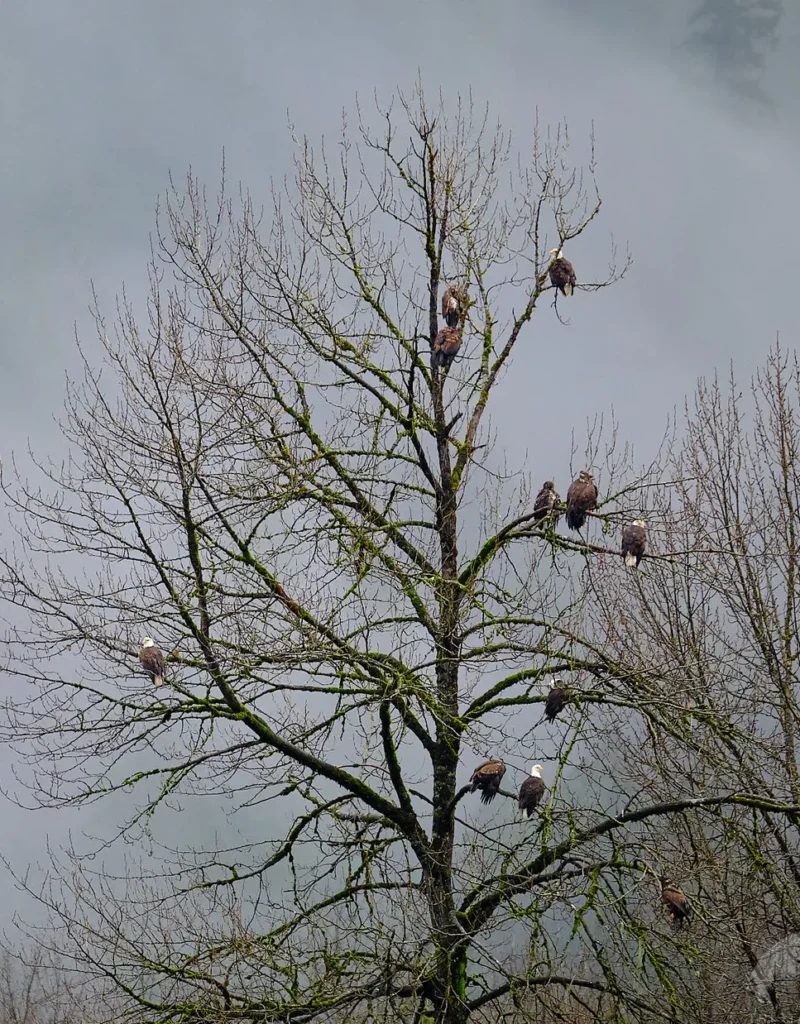
When eagle watching for a survey, try to avoid double counting. It’s good practice to start on one side of an area and work across, noting eagles flying into the area you just counted. Don’t count eagles moving out of a counted area as they might have already been counted.
We’re all super excited to see bald eagles return to Squamish, and we hope you are able to enjoy them as much as we do.
Banner photo credit: Brendan Cummins